An act already lived
Making temporary seating for guests.
What the craft does
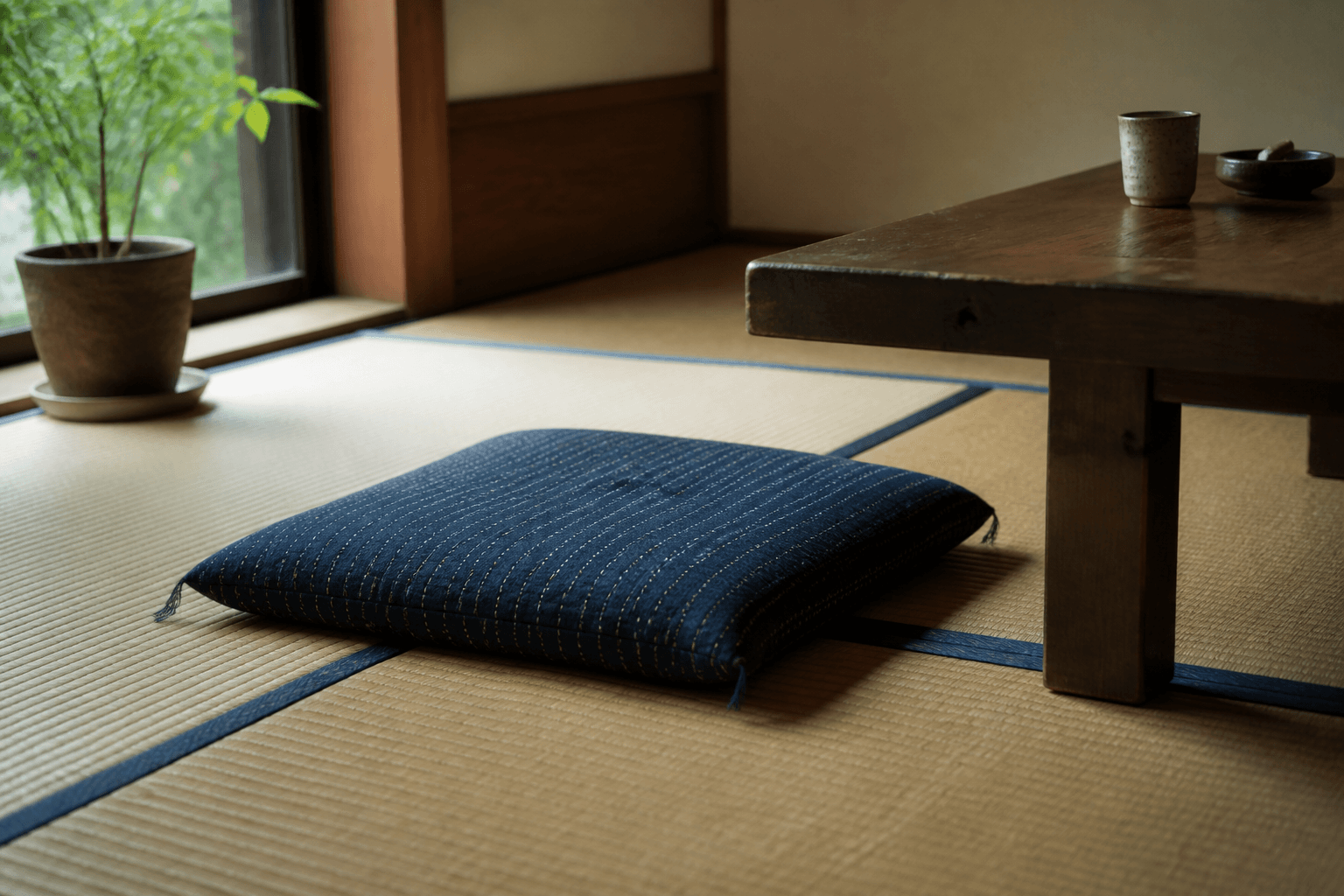
A movable floor cushion supports sitting and stacks away.
Why they connect
A room that changes through the day can gain seating without permanent furniture.
This is an editorial reading of a possible use, not a product or a record of sales.
- FAMILIAR MODEL
- Furniture assigns stable functions: the dining room contains dining furniture; the bedroom contains a bed.
- JAPANESE ALTERNATIVE
- Floor-level, movable objects allow one room to host eating, guests, work, and sleep at different times.
A cushion is part of a spatial system座布団は、空間の仕組みの一部
Taken alone, a zabuton is a square floor cushion. It becomes culturally legible when placed with tatami, a low table, sliding partitions, and storage. Each element assumes that the floor can be occupied directly and that the room may change purpose.
Web Japan traces the modern cotton-filled zabuton to around the middle of the Edo period. Its history developed alongside ways of sitting in which the floor—not a raised chair—forms the common plane of the room.
Chair culture and floor culture椅子の文化と床の文化
A chair raises one body into one designed position. It offers support, status, and a clear personal place. A zabuton marks a place more lightly. It can be added for a guest, moved closer to the table, stacked after use, or removed entirely.
Neither system is universally better. Chairs improve accessibility and long-duration support for many bodies. Floor sitting can be difficult or unsuitable for others. The comparison is useful because it shows how one small object participates in a different theory of space.
The cushion is small because the larger object is the room—and the room is expected to change.
The room does not keep one job部屋は、一つの用途を持ち続けない
In a furniture-heavy room, function remains visible even when no one is using it: the bed still occupies the bedroom; the dining table still occupies the dining room. Traditional Japanese rooms could change more dramatically as bedding, tables, and cushions were brought out and stored.
The efficiency is temporal. Instead of shrinking every piece of furniture, the household reduces how many functions must occupy the floor at the same moment.
Technique supports repeated movement動かすことを前提にしたつくり
A useful zabuton must hold filling evenly enough to support sitting, remain light enough to carry and stack, and survive repeated compression. Fabric, stitching, corner tufts, filling, and proportion all contribute to this quiet infrastructure.
The object’s function is not only comfort. It is reversible occupancy: making a place for a person without permanently claiming the room.
What travels across cultures文化を越えて持ち帰れるもの
Importing a zabuton into a Western apartment does not automatically create Japanese life, and floor sitting should not be romanticized as minimalism. The transferable idea is more precise: some domestic functions can be provided by objects that disappear when the function ends.
A reading corner, guest seat, or low tea setting can exist without becoming permanent furniture. The zabuton offers not an aesthetic shortcut to Japan, but a practical question: how much of a room must stay committed all day?
- Living in a Japanese House: Tatami Mats and Zabuton CushionsWeb Japan, Ministry of Foreign Affairs
- Tatami Room: The Heart of Japanese Contemporary HomeJapan Up Close / Web Japan