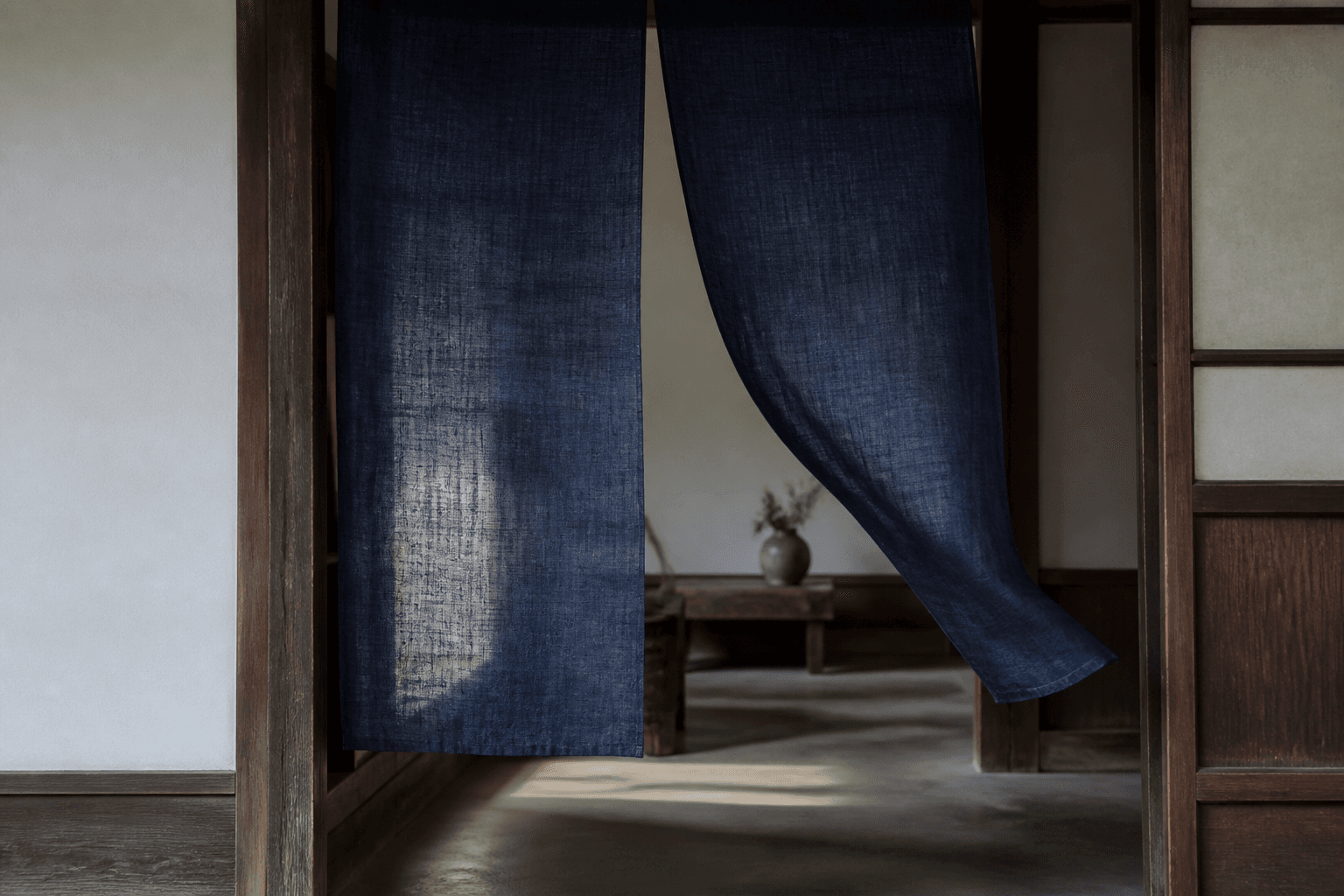
An act already lived
Marking a passage between shared and private space.
What the craft does
Split, movable cloth screens sight while allowing people and air through.
Why they connect
A threshold can feel welcoming without becoming a closed door.
This is an editorial reading of a possible use, not a product or a record of sales.
- FAMILIAR MODEL
- A door makes access binary: open or closed, public or private.
- JAPANESE ALTERNATIVE
- A noren makes the boundary visible while keeping air, light, sound, and people in motion.
The problem with calling it a curtain「カーテン」と訳すと失われるもの
Calling a noren a curtain is not wrong, but it is incomplete. A Western curtain usually belongs to a window and manages sight or light. A noren hangs in a passage. Its central question is not “what can you see?” but “how do you move from here to there?”
That distinction explains its split panels. The opening lets a body pass without drawing the whole textile aside. The cloth gives way, touches the shoulder, and falls back into place. Its form is already an instruction for use.
A shop that speaks before anyone does人より先に、店が語る
Across Japanese streets, a noren can announce that a shop is open, indicate the kind of business inside, shade an entrance, and screen dust or direct sight. Government of Japan material describes it as the “face” of a shop: damage to the noren can even stand metaphorically for damage to a business’s trust and reputation.
A sign communicates information at a distance. A noren adds a physical encounter. To enter, you pass through the business’s identity. Branding, weather protection, and spatial etiquette occupy the same square metres of cloth.
The function is not to close the room. It is to make the boundary legible without making it absolute.
A softer kind of privacy閉じないプライバシー
Many modern interiors solve privacy with opacity: a wall, a solid door, a lock. The noren solves it by reducing the direct line of sight. It makes looking in less automatic while leaving the room connected to what surrounds it.
This is useful where total separation would be excessive: between a kitchen and dining space, at a studio entrance, or across open shelving. Privacy becomes graduated rather than binary.
Technique becomes function技法が機能になる
Traditional examples use cotton or hemp and resist-dyeing methods that keep motifs clear through repeated exposure and handling. The dye is not merely decoration. It strengthens the textile’s identity as a durable working surface, while the fabric remains light enough to respond to air.
That is the central test for Mono Stories: if the craft technique disappeared, would the function become weaker? With a noren, material, dye, cut, weight, and movement combine to produce a boundary that a rigid object cannot imitate.
What it can mean now現代の暮らしへの翻訳
The contemporary appeal of a noren is not nostalgia for an old shopfront. It is a practical response to open-plan life. We increasingly want spaces to change purpose through the day, yet our default tools—walls and doors—make every division heavy.
A noren offers enough separation to change the atmosphere without pretending the room has become somewhere else. It is less architecture than an adjustable agreement between two spaces.
- Noren: The Face of a ShopGovernment of Japan