An act already lived
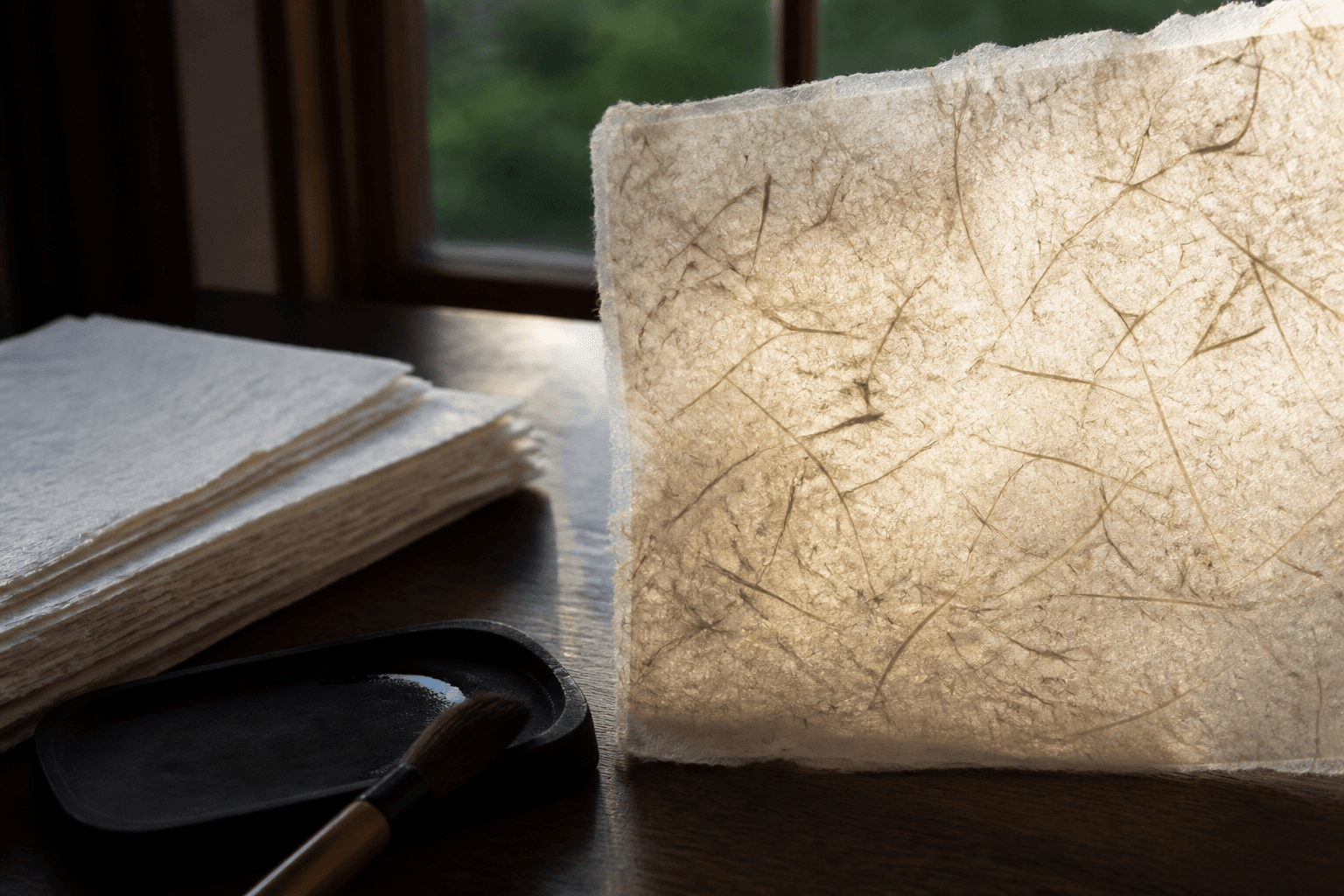
Softening daylight in a room.
What the craft does
Long fibres make paper that can filter light and form a surface.
Why they connect
The familiar wish for gentler light connects with a material built to diffuse it.
This is an editorial reading of a possible use, not a product or a record of sales.
- FAMILIAR MODEL
- Paper is a thin, disposable carrier for text or packaging.
- JAPANESE ALTERNATIVE
- Washi is a fibre structure that can transmit light, form surfaces, and remain useful for generations.
The translation problem in one word「paper」では足りない
Translate washi as “Japanese paper” and the listener may imagine stationery with a decorative texture. That image is too small. Washi has been used for letters and books, but also for screens, partitions, doors, lamps, restoration, printing, and wrapping.
The category changes when the material enters architecture. A sheet can soften daylight across a room, cover a join, or create privacy without making the interior opaque.
Long fibres, different behaviour長い繊維が生む性質
UNESCO describes traditional washi-making as a process using paper-mulberry fibres: separating and preparing the fibres, suspending them in water, and forming sheets through a screen. The visible strands in handmade paper are not decorative additions; they are the material’s structure.
Long, interlaced fibres help explain why some washi can remain thin while resisting tearing and flexing around surfaces. Technique becomes strength without requiring the thickness we associate with cardboard or cloth.
When paper becomes strong enough to divide a room, “paper” stops naming a category and starts naming a material possibility.
Light instead of transparency透明ではなく、光を通す
Glass gives a view; a wall blocks it. Washi creates another condition. Light passes through while detail is diffused, turning illumination into atmosphere and privacy into a gradient.
That middle state appears repeatedly in Japanese spatial culture: shoji, noren, screens, and layered thresholds. Boundaries do not disappear, but they need not become visually or physically absolute.
Disposable is not inherent to paper紙は、使い捨てとは限らない
Modern paper is often designed for high-volume sameness and short use. Handmade washi reveals that disposability is not a property of “paper” itself. It is the result of fibres, production, intended use, and economic design.
Some washi traditions support conservation and restoration precisely because the material can age with, reinforce, or repair other paper objects. A humble sheet can function as a long-term technical material.
How to look before buying買う前に見ること
Ask which fibre is used, where and how the sheet was made, whether it is intended for writing, printmaking, lighting, repair, or interior use, and what care it requires. “Washi” alone does not guarantee a particular method or quality.
The most meaningful purchase is not the paper that looks most visibly rustic. It is the sheet whose fibres and making process produce the function you actually need.
- Washi, craftsmanship of traditional Japanese hand-made paperUNESCO Intangible Cultural Heritage