An act already lived
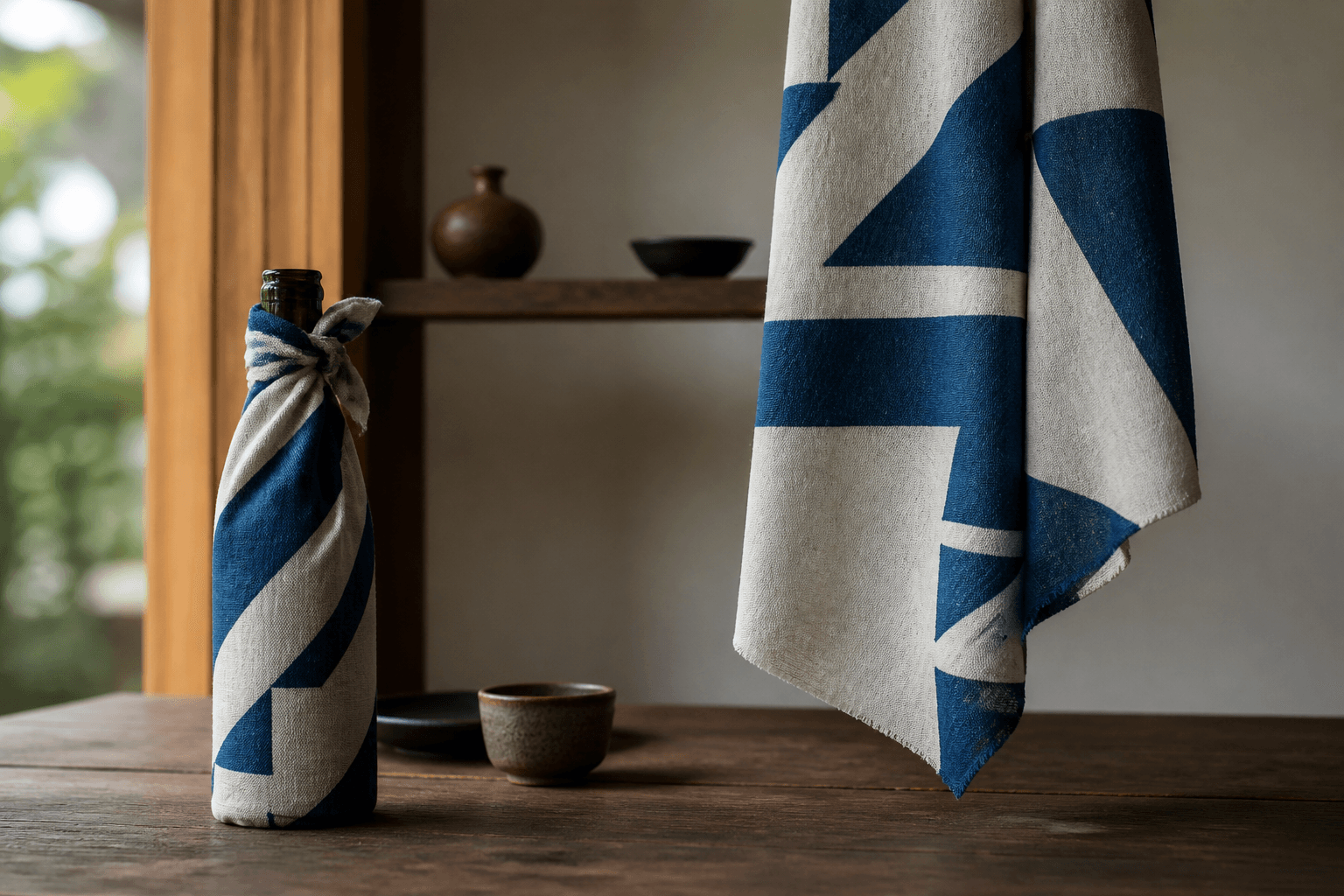
Keeping a cloth at hand for carrying, drying, and wrapping.
What the craft does
A thin cotton rectangle folds small and dries quickly.
Why they connect
The repeated need for a useful cloth fits a textile designed for many jobs.
This is an editorial reading of a possible use, not a product or a record of sales.
- FAMILIAR MODEL
- A product proves its value by being optimized for one named job.
- JAPANESE ALTERNATIVE
- A tenugui keeps its construction minimal so the user can assign the job repeatedly.
Do not begin with the towel comparisonタオルとの比較だけで見ない
A terry towel is thick, absorbent, soft, and slow to become anything other than a towel. A tenugui is a thinner cotton rectangle. It holds less water at once, but dries quickly, folds flat, ties easily, and can wrap close to irregular shapes.
The apparent weakness—lack of bulk—is the source of adaptability. The same piece can dry hands, cover the head, protect an object, wrap a bottle, strain, decorate, or serve as a small gift cloth.
Why the ends are left open端を縫わない理由
Traditional tenugui are often left unhemmed at the short edges. The raw ends can fray at first, but they also release water, dry faster, and avoid a thick seam that would hold moisture or resist a close knot.
This is a useful design lesson: finishing every edge can make an object look more complete while making it less suitable for its actual environment.
The tenugui is not a worse towel. It is a different answer to the question of how many objects one cloth should become.
Dye on both sides裏まで染まる注染
Tokyo’s official traditional-craft guide describes chusen, a dye-pouring method used for yukata and tenugui. Dye is poured by hand through prepared areas of cloth, creating characteristic gradation and a pattern that reads through the textile rather than sitting only on top.
That matters in use. A cloth that will be folded, twisted, tied, and seen from changing angles benefits from having no obvious “display side.” Technique supports spatial freedom.
The anti-specialist object専用品の反対側
Industrial design often removes ambiguity: icons tell us where to grip, seams define capacity, and moulded parts prevent alternative use. This reduces learning time and can improve safety. But a house filled only with specialist objects also fills quickly.
The tenugui asks more of the user and less of the cupboard. Its knowledge lives partly in the textile and partly in the repertoire of the person using it.
A practical first week最初の一週間
Use one as a hand cloth, then wash and hang it. Try it the next day as a lunch wrap or bottle carrier. Notice not only whether it performs each task, but how quickly it returns to being a simple flat rectangle.
Its value is not that it replaces every towel or bag. It is that one modest object can absorb the small, unpredictable jobs that specialized products leave between them.
- Tokyo Honzome Yukata and TenuguiTokyo Metropolitan Government