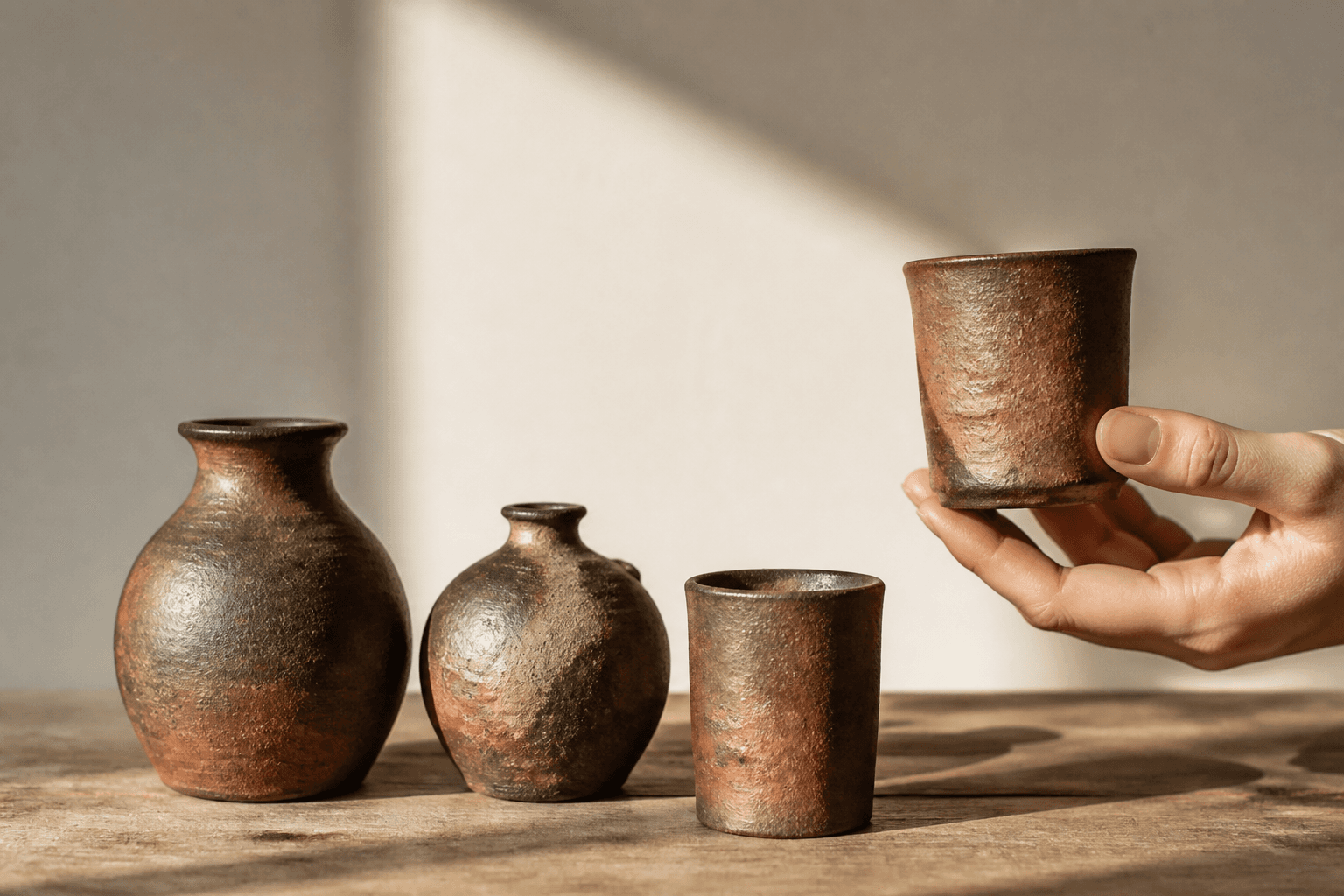
An act already lived
Serving food and sharing a table.
What the craft does
Bizen stoneware is formed and fired for repeated use.
Why they connect
Everyday meals offer a reason to use, care for, and eventually commission craft again.
This is an editorial reading of a possible use, not a product or a record of sales.
- FAMILIAR MODEL
- Heritage is protected by removing fragile things from ordinary life.
- JAPANESE ALTERNATIVE
- Living craft survives when careful use creates demand for making, teaching, repair, and replacement.
An object and a practice are different things物と技術は、同じではない
A pot can survive after the knowledge used to make it has disappeared. This is the paradox of material heritage: the evidence may remain while the living system—clay preparation, kiln loading, firing judgment, tool making, apprenticeship—quietly ends.
UNESCO therefore treats traditional craftsmanship as intangible heritage. The safeguarding target is not only the object, but the knowledge and skills that allow communities to keep producing it.
Why Bizen makes the argument visible備前焼が見せるもの
Bizen ware is associated with high-fired, unglazed pottery. Without a coating of glaze to standardize the surface, clay, flame, ash, placement, and firing conditions remain legible in the finished vessel. Variation is not a defect added after the design; it is a record of how the object came into being.
This is where “craft” becomes more than decoration. The technique produces hardness, tactile surface, natural markings, and one-of-a-kind differences. Function and appearance share a cause.
Preservation protects the result. Demand helps preserve the ability to make the next one.
The economics hidden inside one cup一つの器に隠れた経済
A workshop needs more than admiration. It needs enough reliable orders to buy material, maintain equipment, reserve kiln time, pay people during slow processes, and allow a less-experienced hand to learn without every mistake becoming catastrophic.
No single purchase “saves” a tradition. That language makes the buyer heroic and the maker passive. A healthier account is reciprocal: the buyer receives a useful object; the workshop receives demand that can support another cycle of work.
Use is not the opposite of care使うことは、雑に扱うことではない
People often protect an expensive handmade object by not using it. The instinct is understandable, but it can make the craft irrelevant to daily life. Careful use offers another form of respect: learning how the material changes, cleaning it correctly, accepting patina, and repairing when appropriate.
The goal is neither precious isolation nor careless consumption. It is a long relationship in which wear becomes information rather than automatic evidence of failure.
What belongs in a Mono Stories collectionMono Storiesが届けるものの基準
This is why Mono Stories does not choose whatever traditional-looking stock can be acquired fastest. We look for traceable objects whose origin, maker or workshop, technique, care, and contemporary use can be explained without invention.
The editorial work establishes the standard. An object offered for sale should make clear why its technique creates its function—and why this particular object deserves a place in someone’s life.
- Traditional craftsmanshipUNESCO Intangible Cultural Heritage
- Bizen YakiJapan Traditional Crafts Aoyama Square
- Japan’s Six Ancient KilnsGovernment of Japan