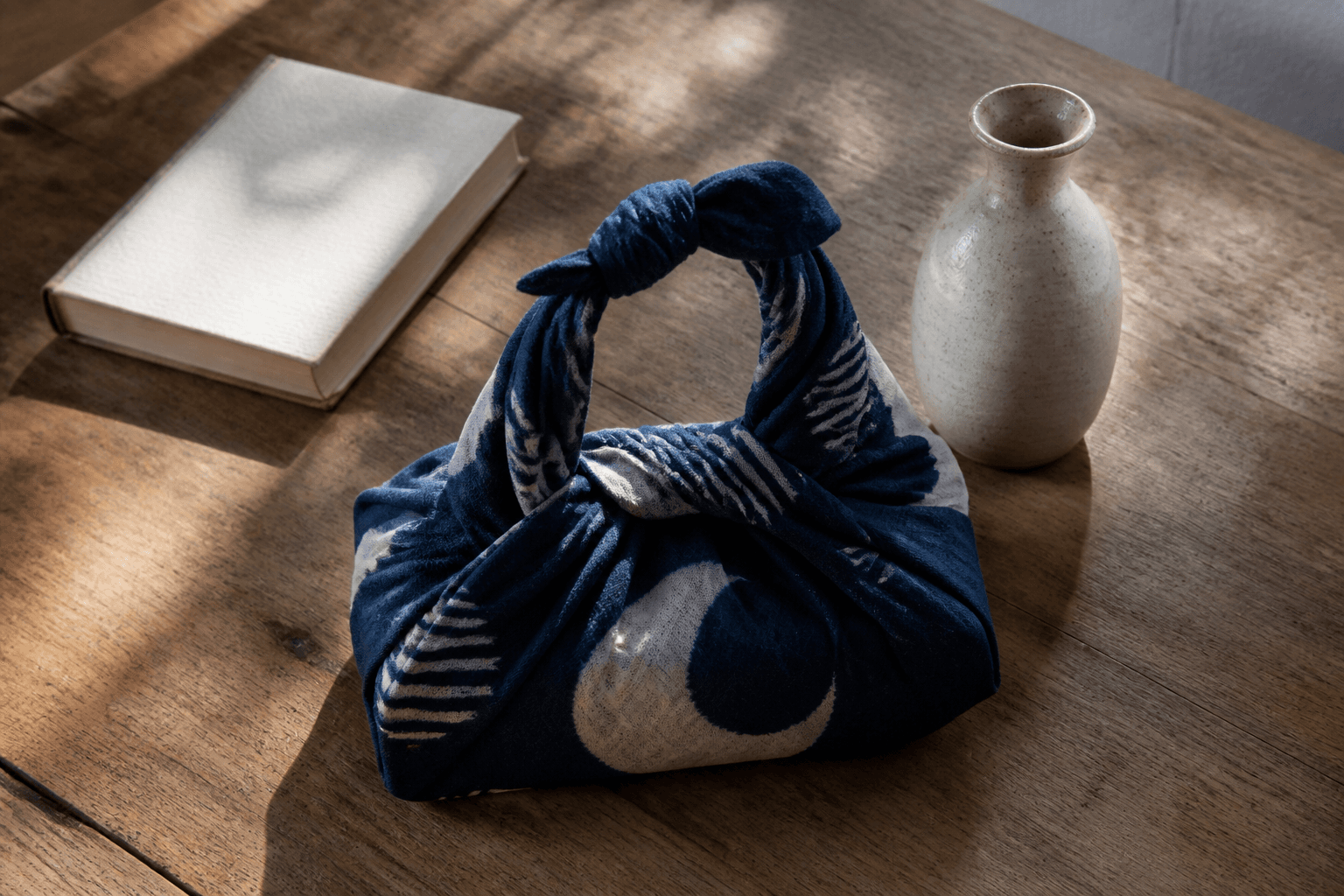
An act already lived
Wrapping and giving a gift.
What the craft does
A durable square of cloth and a knot adapt to different objects.
Why they connect
The gift-giving act already exists; the wrapping can be kept and used again.
This is an editorial reading of a possible use, not a product or a record of sales.
- FAMILIAR MODEL
- Packaging is engineered for one product and usually becomes waste after one journey.
- JAPANESE ALTERNATIVE
- A furoshiki stays geometrically open, changing form around each new object.
Start with almost no shape形を決めないことから始める
A tote bag has handles, seams, and a fixed opening. Those features make it immediately understandable, but they also decide what the object will be. A furoshiki begins as a square. Its usefulness is latent until cloth and object meet.
The knot provides the temporary structure. Move the knot and the same textile becomes a bottle carrier, book wrap, lunch cloth, gift covering, or improvised handle. The user finishes the design each time.
Wrapping as a verb, not a product包装ではなく、包むこと
Contemporary packaging is usually a noun: a box, sleeve, pouch, or mailer. Furoshiki is better understood through the verb tsutsumu—to wrap or envelop. The important technology is a repeatable action rather than a disposable container.
This makes care visible. The wrapped form changes with the contents, so the giver’s handling remains present in the final shape. Opening is not destruction; it is simply the reversal of the fold.
Its intelligence comes from refusing to become one particular kind of bag.
Old practice, current logic古い習慣、現代的な合理性
Japan’s Ministry of the Environment has promoted furoshiki as an example of mottainai: making full use of an item’s value. Its official guidance emphasizes the cloth’s ability to wrap differently shaped goods, fold down small, resist tearing, and be reused.
That does not make every furoshiki automatically more sustainable than every bag. Material, production, washing, transport, and frequency of use all matter. The strongest claim is simpler: repeated use is built into the object’s form.
Technique becomes adaptability技法が可変性になる
Cloth must withstand tension at a knot without becoming too bulky to tie. Size, weave, edge treatment, friction, and drape determine which loads it can hold. A beautiful pattern cannot compensate for fabric that slips or a knot that cannot be released.
This is the causal story Mono Stories wants to make visible: a flexible textile plus a learned knot produces many functions with very few permanent parts.
The modern test現代の暮らしで試す
Keep one furoshiki where single-use packaging usually appears: in a work bag, near the front door, or with gift supplies. Learn two knots rather than twenty. Repetition matters more than mastery.
If the cloth returns to the drawer after each job, it is not failed packaging. It is infrastructure waiting for another object.
- Mottainai FuroshikiMinistry of the Environment, Japan
- 3R Initiative: Ways to tie a furoshikiMinistry of the Environment, Japan