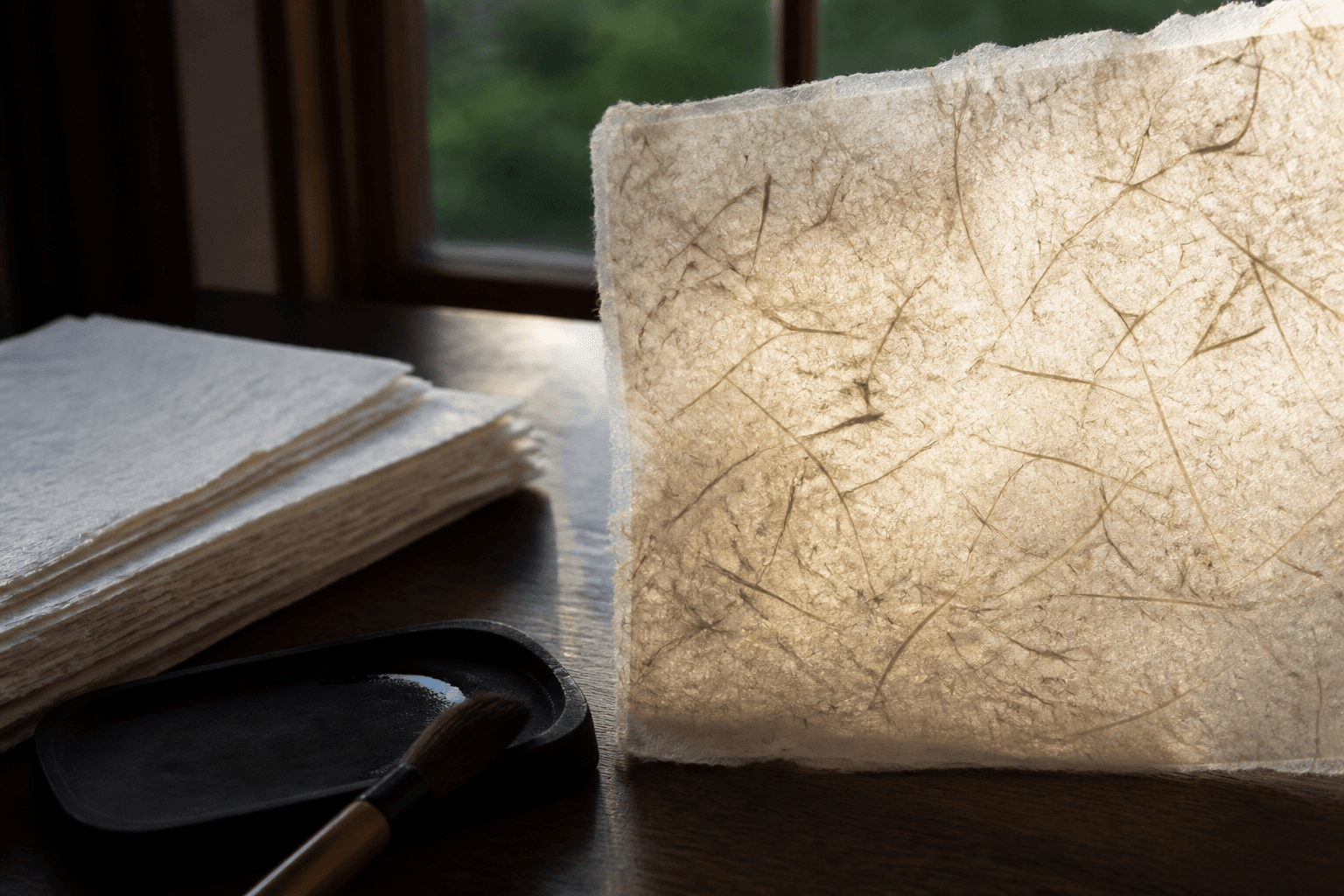
Washi — Japanese handmade paper — arrived from China in the 7th century and within two hundred years had become something entirely different from its origin: thicker, stronger, more translucent, and capable of lasting a thousand years without brittleness. The key was the fiber: kozo (paper mulberry), gampi, and mitsumata, harvested from mountain shrubs, boiled in lye, beaten by hand, and formed into sheets one at a time in a water suspension.
Echizen, in Fukui Prefecture, has been making washi since the 5th century — longer than almost any other site in Japan. The town's founding myth involves a mysterious woman appearing at the river's edge and showing the locals how to make paper from the plants growing on the bank. Today, Echizen's 70-odd remaining papermakers carry the same process forward.
Washi-making begins with the harvest: kozo stalks are stripped, steamed, and the outer bark removed by hand. The inner bark is cooked in wood ash lye, then washed in cold running river water for hours until perfectly clean. It is beaten — by wooden mallets or by stone — until the fibers separate completely.
The sheet is formed by suspending the beaten fiber in a vat of water mixed with neri, a natural slime from the roots of tororo-aoi (sunset hibiscus). The papermaker scoops the vat with a bamboo frame and screen, shaking it in a precise figure-eight motion to interlock the fibers. Each sheet is pressed, then dried on a wooden board in the sun. The whole process takes two days per batch.