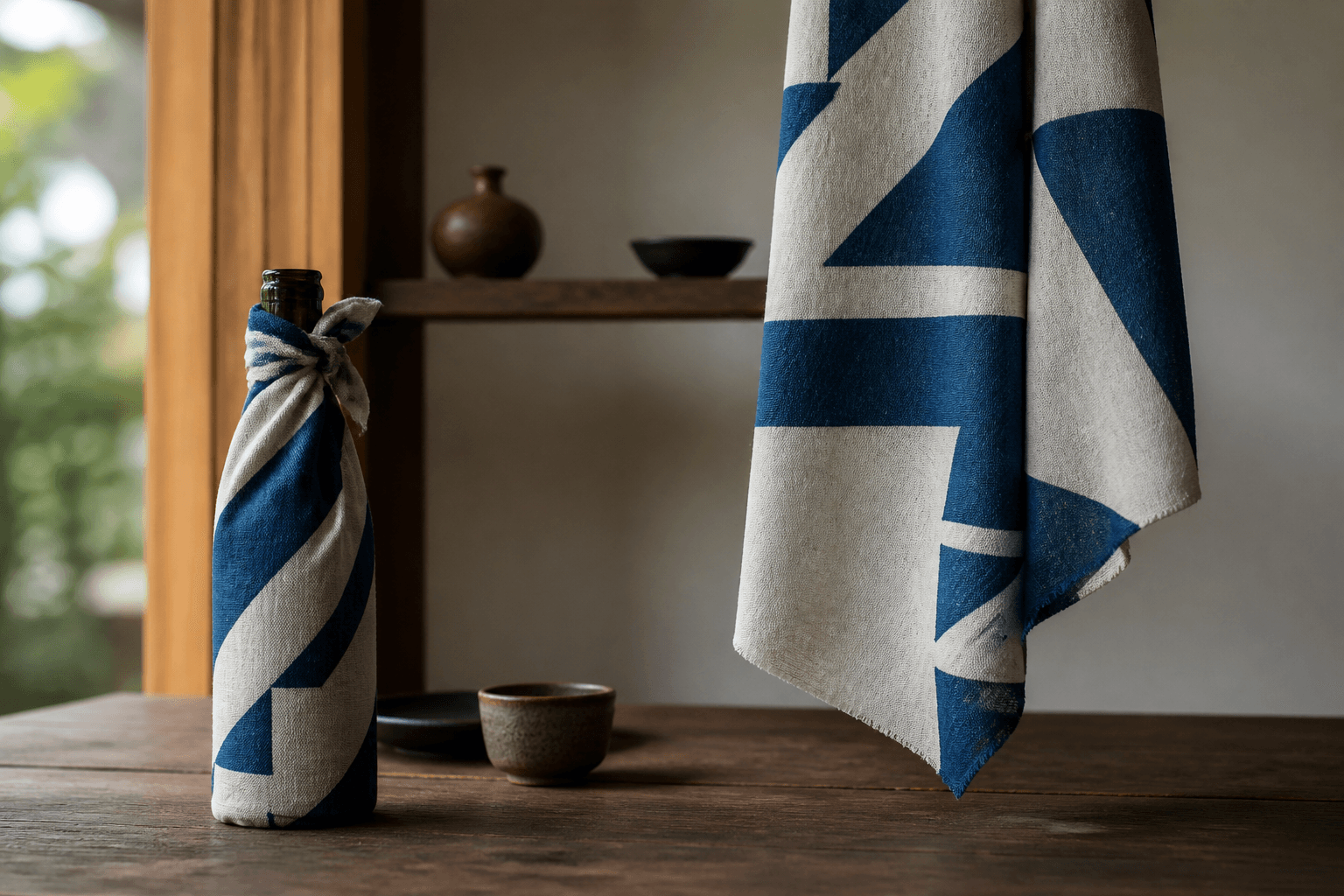
The tenugui — a plain-woven cotton rectangle, roughly 35cm by 90cm, cut raw on both short ends — has been in continuous use in Japan since the Heian period. Its genius is what it doesn't have: no hem on the cut ends (which allows it to dry faster), no loop for hanging (it doesn't need one), no thickness that might harbor mold. It is the minimum possible cloth that can dry a hand, wrap a head, cool a neck, or cover a wound.
By the Edo period, tenugui had become a form of advertising and social currency. Kabuki actors gave printed tenugui to fans; shops gave them to loyal customers; bathhouses provided them to patrons. The dyeing tradition — particularly the chusen method, where dye is poured through folded layers of cloth — allowed for precise, graphic patterns unique to Japan's textile history.
The finest tenugui are made with chusen dyeing: the undyed cotton is folded accordion-style onto a table, and dye is poured from a jug through a paste-resist stencil. Gravity does the work; the dye seeps through every layer simultaneously, creating patterns that are identical on both sides. The craftsman controls only the pour — angle, speed, height — and no two chusen pieces are ever exactly the same.
The raw-cut ends are intentional, not unfinished. They fray slightly with washing, then stabilize into a soft border. A tenugui that has been washed 200 times is softer and more absorbent than a new one — the opposite of most textiles.