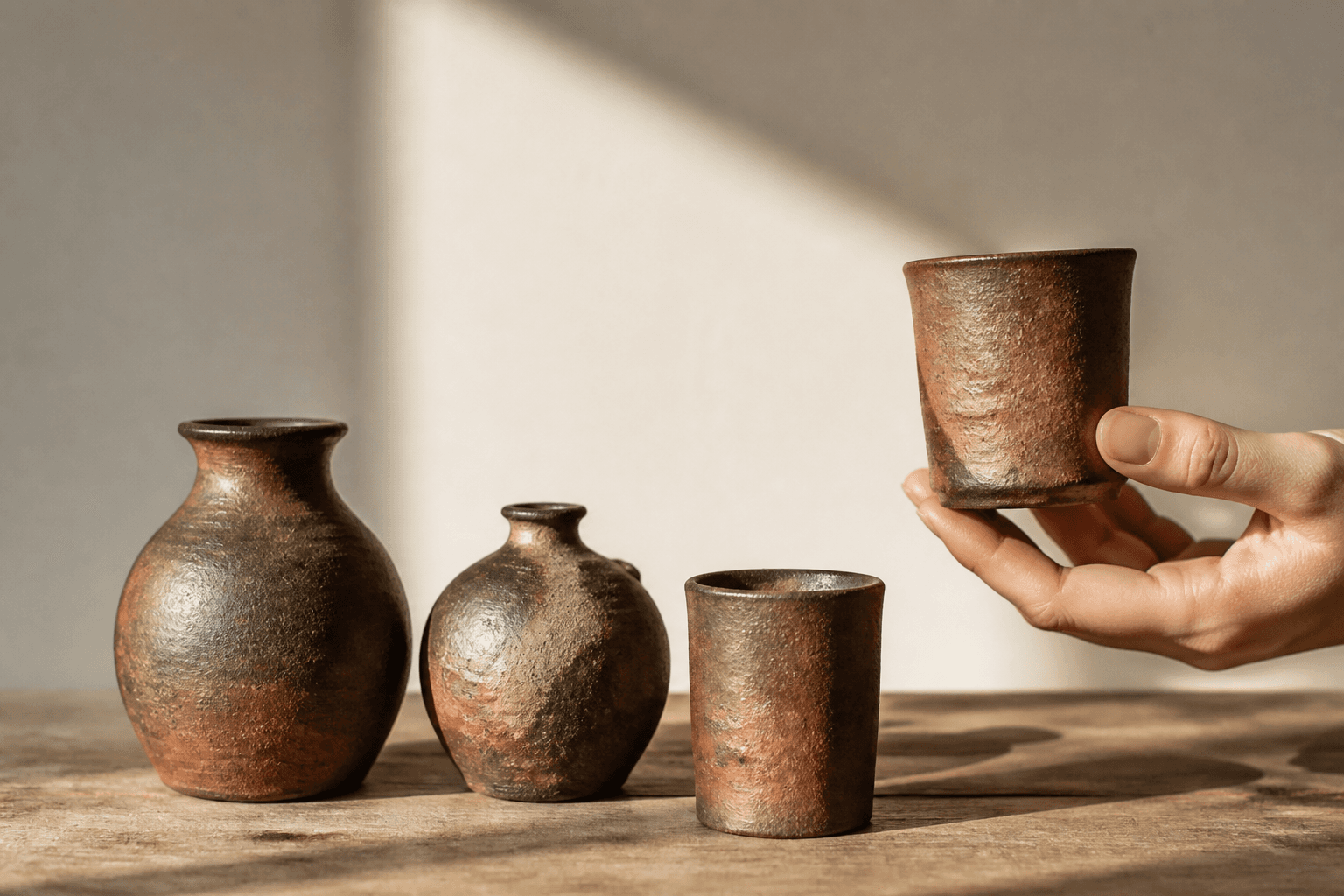
Bizen is one of Japan's "Six Ancient Kilns" — a ceramic tradition unbroken for over a thousand years in the hills east of Okayama. Unlike most Japanese ceramics, Bizen uses no glaze, no painting, no colored slip. The clay is everything: a heavy, iron-rich earth excavated from the local mountains, aged for months in open pits, then fired in wood kilns at 1300°C for ten to fifteen days straight.
The colors and patterns that emerge — the orange fire marks (hidasuki), the dark surface burns (sangiri), the gray ash deposits (goma) — are entirely determined by where in the kiln the piece was placed, what wood burned nearest to it, and how the fire moved over ten days. The potter proposes; the kiln decides.
Bizen clay is thrown on the wheel in a high-iron state that would cause most potters problems: it cracks under rapid temperature changes, it warps if dried too fast, it collapses if the walls are too thin. Bizen potters work with the clay's stubbornness rather than against it — the forms are thick, low, and wide for a reason.
The firing is communal. Several potters share a single climbing kiln (noborigama), loading it together and tending the fire in shifts around the clock. A piece placed near the firebox will be dark and dramatic; one near the chimney will be paler and quieter. The assignment of positions in the kiln is a form of collaboration with fire.